Frequently Asked Question
Force estimate
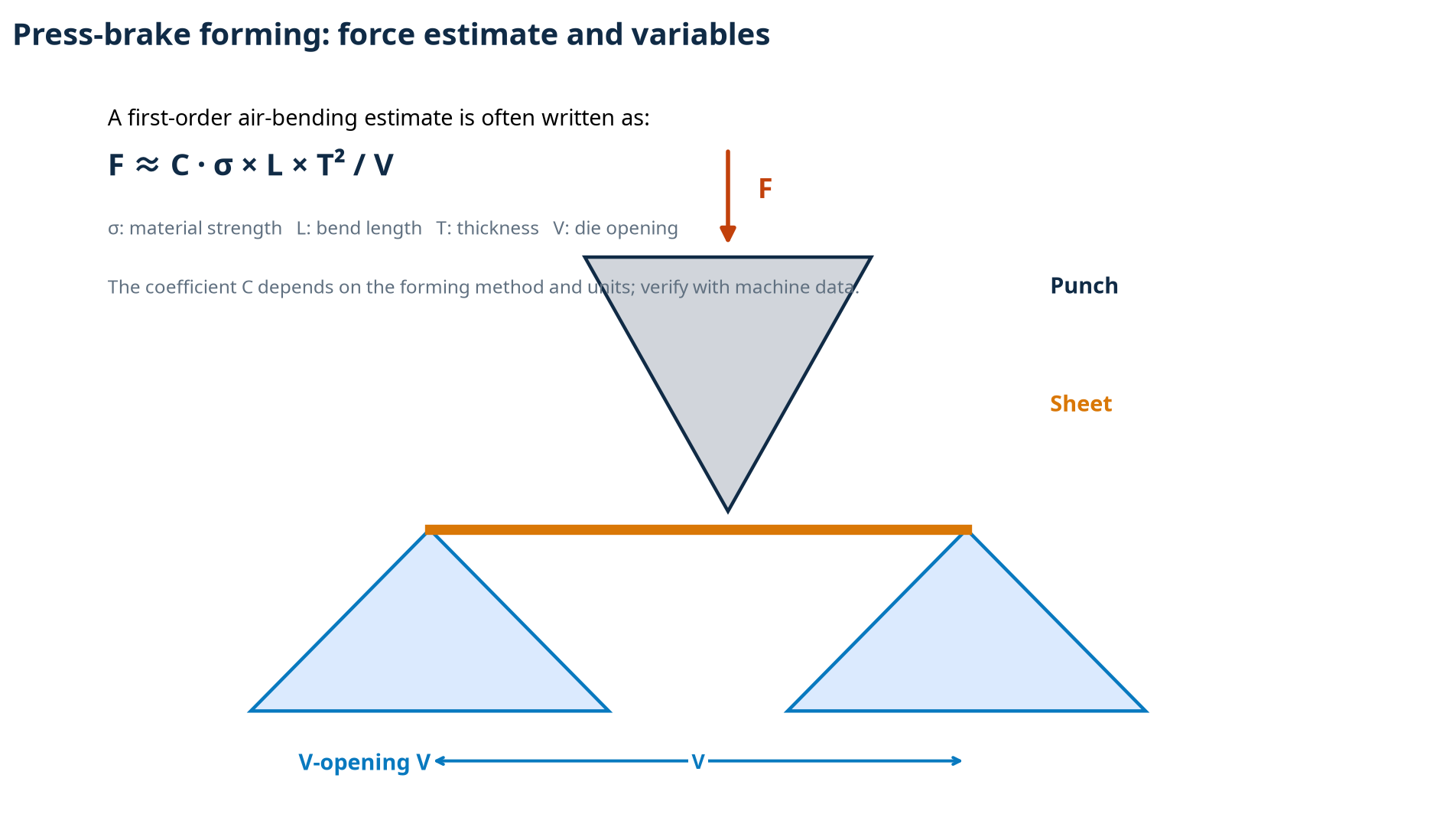
Forming force is influenced by material strength, thickness, bend length, die opening, radius, friction, and forming method. The thickness term is especially important: doubling thickness can increase a first-order force estimate by approximately four times when other variables remain unchanged. The estimate is for capacity screening and setup planning; machine rating, tooling limits, deflection, workholding, and actual material data must still be checked.
F is force, σ is a representative material strength, L is bend length, T is thickness, V is die opening, and C contains method and unit effects. Different forming methods require different coefficients.
Worked example
If thickness changes from 1.5 mm to 2.0 mm while material, length, and die opening remain unchanged, the thickness ratio is 2.0/1.5 = 1.333. The simplified force ratio is 1.3332 = 1.78, so the thicker sheet requires roughly 78% more force in this comparison.
Engineering check: confirm rated force, concentrated loading, punch and die capacity, minimum flange, machine deflection, and operator protection before production use.
Engineering check
For Sheet-Metal Bend Force Estimation, record the material condition, tool or fixture identity, process settings, measurement method, sampling plan, and reaction rule. Confirm that the measurement system is capable of resolving the requirement and that the process is stable before using capability or first-article data to justify release. Reconfirm the limits after a material, tool, or route change.