Frequently Asked Question
Elastic recovery
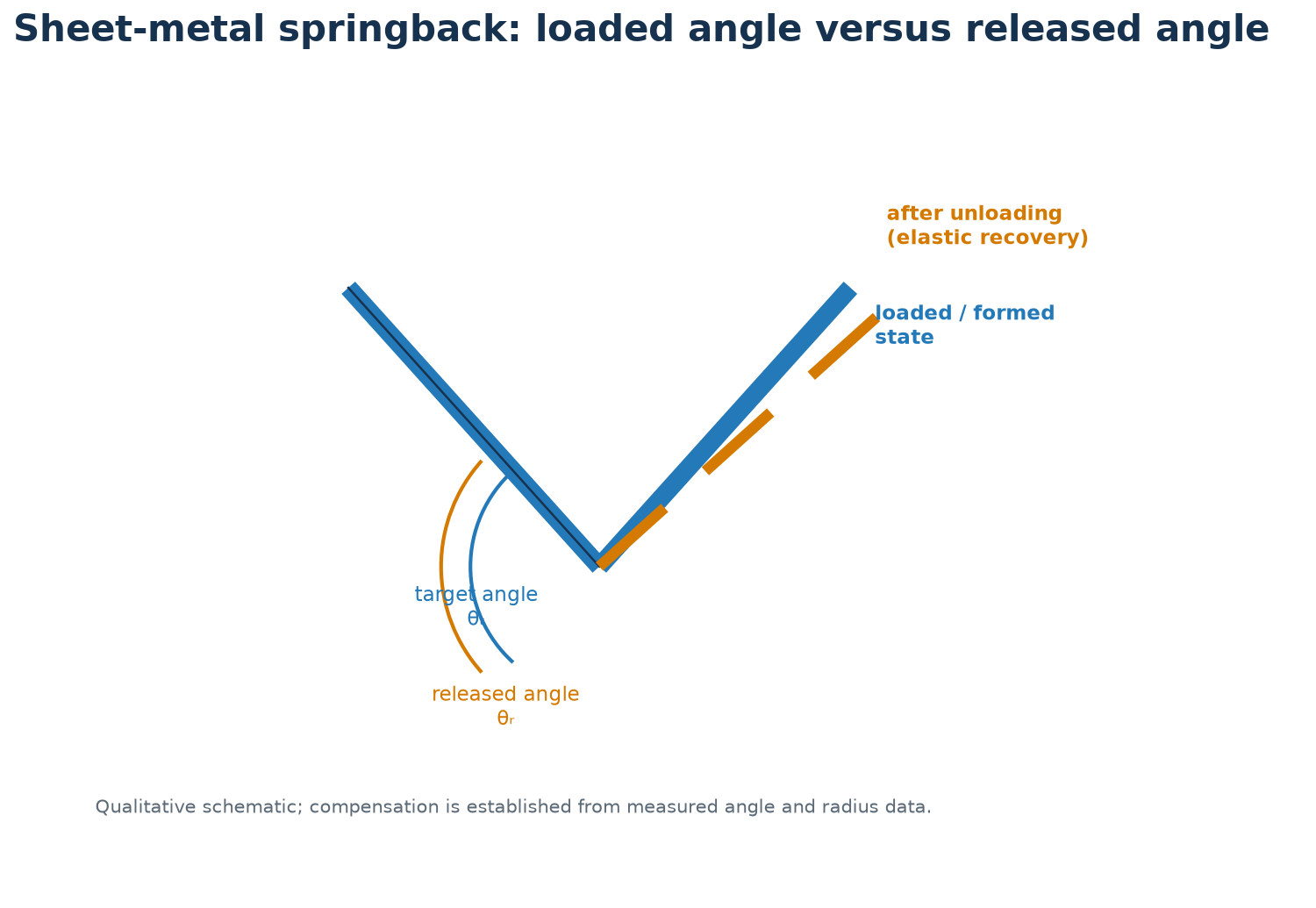
Plastic bending also stores elastic strain. When the punch load is removed, the elastic portion recovers and the bend opens or its radius changes. Springback generally increases with material strength and decreases as the amount of plastic curvature increases. Thickness, inside radius, grain direction, die opening, friction, and forming method also influence the result.
Worked example
A target included angle of 90° measures 92° after unloading. The process therefore has a 2° opening error under the recorded setup. A first correction might over-bend to a measured angle near 88°, but this is not a universal rule. Make a second coupon and record material condition, thickness, radius, tool identity, lubrication, bend direction, and measured angle before approving the correction.
Control: separate angle variation from radius variation. Recheck both after material changes, tooling changes, or a change in grain orientation.
Engineering check
For Sheet-Metal Springback and Angle Compensation, record the material condition, tool or fixture identity, process settings, measurement method, sampling plan, and reaction rule. Confirm that the measurement system is capable of resolving the requirement and that the process is stable before using capability or first-article data to justify release. Reconfirm the limits after a material, tool, or route change.
Process-control note
For Sheet-Metal Springback and Angle Compensation, the calculation is only one part of the manufacturing decision. Define the drawing characteristic and its functional datum, identify the process variable that moves it, establish a measurement method with suitable resolution, and record the material, tool, fixture, revision, and sampling window. Confirm the result with a first-article or capability study representative of production. If the process changes, reassess the underlying failure mechanism instead of carrying old settings forward unchanged.