Frequently Asked Question
Developed length
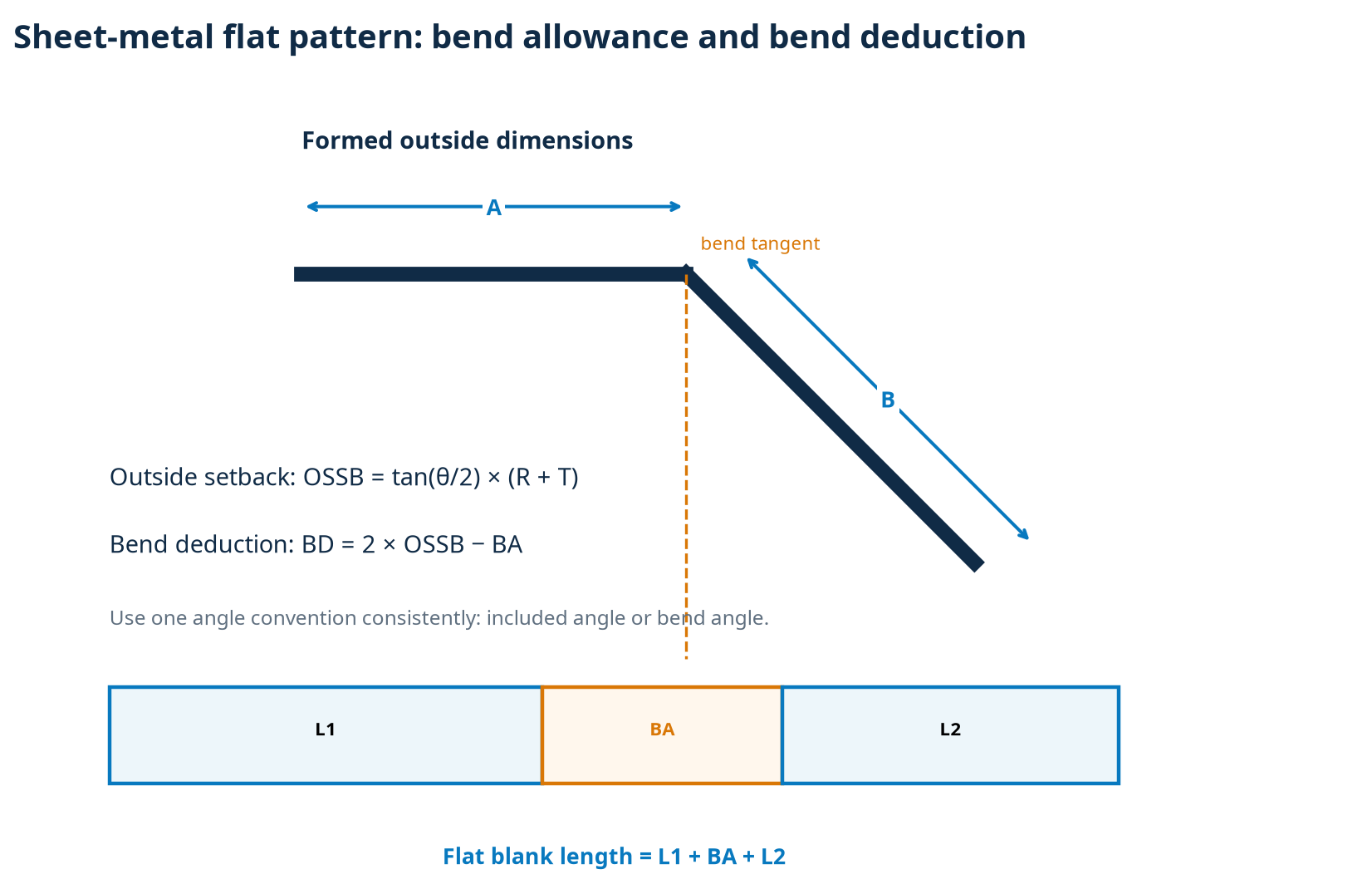
A flat pattern is developed along the neutral axis, not by simply adding outside leg dimensions. The calculation requires a clear definition of leg dimensions, inside radius, material thickness, bend angle, and the reference used for the bend tangent. Outside setback is the distance from the bend tangent to the outside intersection. Bend deduction converts formed outside dimensions into the corresponding blank length.
OSSB is outside setback, BD is bend deduction, and L1 and L2 are leg dimensions measured with the same convention used in the drawing.
Worked example
Let L1 = 40 mm, L2 = 60 mm, R = 3 mm, T = 2 mm, θ = 90°, and BA = 5.969 mm ≈ 5.97 mm. The developed length measured along the neutral axis is 40 + 60 + 5.969 = 105.969 mm ≈ 105.97 mm. If the drawing dimensions are outside dimensions, calculate OSSB and use BD rather than adding BA to those dimensions.
Inspection: verify the first blank and first formed part at functional datums. A correct formula cannot repair a wrong angle convention or an unclear dimension reference.
Engineering check
For Bend Deduction and Flat-Pattern Development, record the material condition, tool or fixture identity, process settings, measurement method, sampling plan, and reaction rule. Confirm that the measurement system is capable of resolving the requirement and that the process is stable before using capability or first-article data to justify release. Reconfirm the limits after a material, tool, or route change.